
 EN

Insulated Tarp Buying Guide For Winter Sites
Concrete rarely fails in January. It fails in April, when a surface that froze begins to scale. Fresh concrete has to hold about 50 °F (10 °C) for the first days after placement so the cement can hydrate, and ACI 306R treats that figure as the working floor. A single-sheet cover traps almost nothing: wind strips the air film beneath it and the sheet turns into a radiator on a clear night. An insulated tarp interrupts that path and holds the heat the pour generates long enough for strength to develop.
Why Winter Construction Needs An Insulated Tarp
The photo above shows the second common job: a facade wrap during a winter renovation, with scaffolding and hoarding on site. Same physics, different failure mode. An insulated tarp keeps the envelope and the trades inside it out of wind chill, meltwater and freeze-thaw cycling, which is where winter construction budgets are usually lost.
What An Insulated Tarp Is Made Of
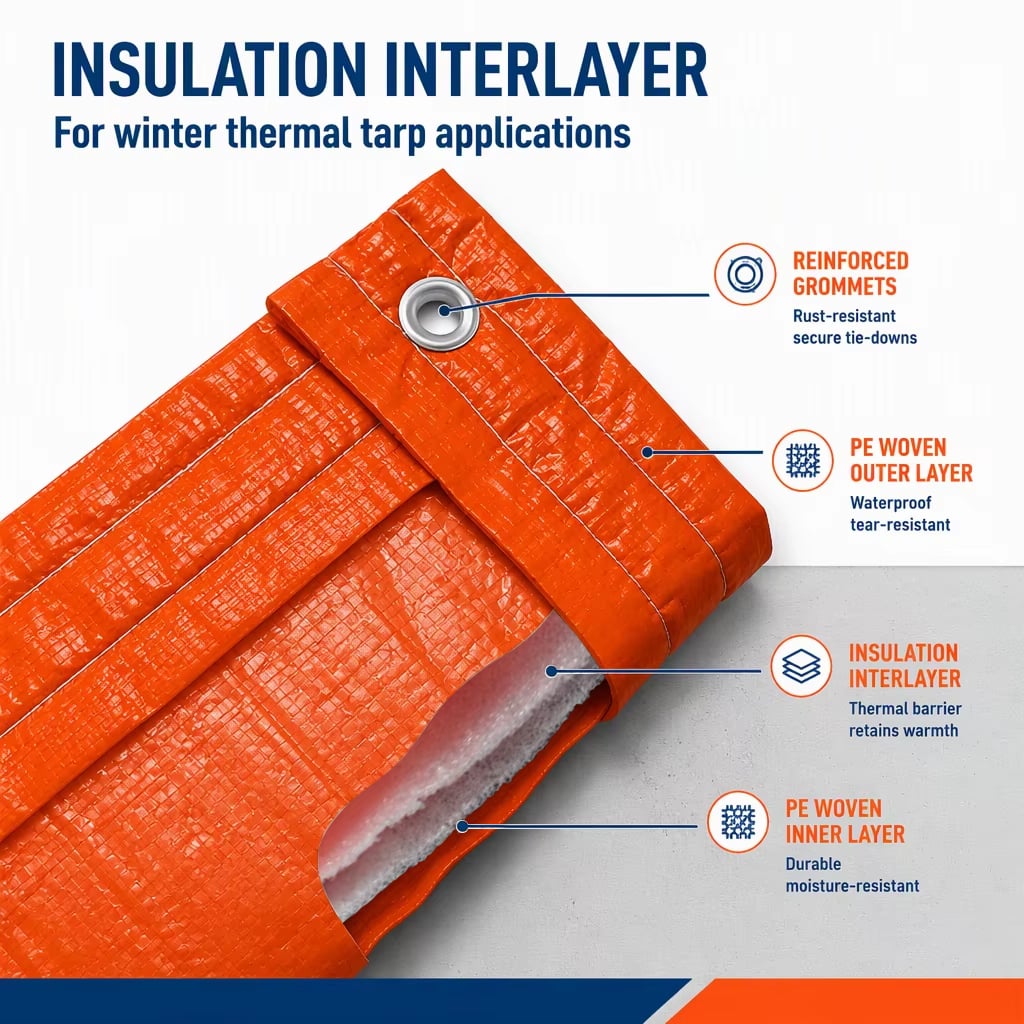
Every insulated tarp is three plies: a woven polyethylene or PVC face, a core, and a liner or scrim that holds the core flat. The face takes UV, wind and abrasion. The core does the thermal work. The liner stops the core shifting when the cover drags across a scaffold.
Face weight, quoted in GSM or oz/yd², sets tear strength and UV life. The core sets thermal performance. Neither number alone tells you whether an insulated tarp suits your job, so the table below pairs them.
|
Build |
Face weight |
Core |
Best fit |
Trade-off |
|
Single-ply PE tarp |
Light to medium |
None |
Rain screen, short pours |
No thermal value |
|
Foam-core insulated tarp |
Medium to heavy |
Closed-cell PE foam |
Facades, columns, wall curing |
Heavier roll |
|
Fiber curing blanket |
Light to medium |
Nonwoven fiber |
Flat slabs, bridge decks |
Wicks water |
|
Scaffold sheeting |
Light |
Air gap only |
Debris containment |
Not a barrier |
|
Rigid XPS board |
Not applicable |
Extruded polystyrene |
Formwork, repeated reuse |
No flexibility |
Treat these bands as orientation only. Confirm exact GSM and R-value on the datasheet of the insulated tarp you are quoted, not on a generic brochure.
Reading R-Value On An Insulated Tarp
R-value measures resistance to heat flow in ft²·°F·h/BTU, and RSI in metric units. It is a lab figure for a flat, dry, uncompressed sample, and an insulated tarp on site is none of those things.
Three effects pull real performance below the label. Seams compress the core, so a welded insulated tarp holds closer to its rating than a sewn one. Wind presses the cover against the wall and the air gap closes. Moisture is the third: a wet fiber core conducts far better than a dry one, which is why closed-cell foam dominates freeze-thaw work.
Ask which method produced any number you are quoted. ASTM C518 is the steady-state heat-flow-meter method. An insulated tarp datasheet quoting an R-value without a method is a marketing figure, not an engineering one.
Cross-Section Or Cut Sample Of The Insulated Tarp
Catalog photos show the face, so buyers compare color and GSM while the ply that matters goes unexamined. Ask for a cross-section photo or a cut sample of the insulated tarp from the production run, not a swatch from a sample room. A supplier who cannot show you the core is selling a coated sheet with a thermal claim stapled to it.
One clarification saves quotation cycles: a curing blanket is a cousin of the insulated tarp, not a synonym. Curing blankets run thinner and suit flat slabs. Vertical work needs a heavier face, tighter grommet spacing and a core that will not drink meltwater.
Grommets, Seams And Wind Load On The Insulated Tarp
Most insulated tarp failures are not thermal. They are mechanical: a grommet tears out at 3 a.m., the sheet peels back, and the pour is exposed by dawn.
Common industrial spacing runs near 2 ft (60 cm) on the perimeter, with reinforced patches at corners. Tighter spacing costs more per square meter and pays for itself the first time a gust hits. Cold stiffens the film while wind works every grommet like a pull test, so an insulated tarp rated well in July can fail in its first February.
Plan the tie-down before the cover arrives. Rope through a grommet pulls at one point; webbing along a hem spreads the load over a meter. On exposed sites, run a cable through the grommet line and tension from the frame, not from the fabric of the insulated tarp.
Eight Questions Before You Order An Insulated Tarp
Put these in the first email before you order an insulated tarp. The answers separate a mill from a trading desk.
- Face GSM, weave count, UV stabilization in kLy.
- Core material and thickness.
- Quoted R-value and the test method behind it.
- Flame standard tested against, such as NFPA 701 or EN 13501-1.
- Grommet material, inside diameter, spacing, corner patch build.
- Seam process: welded, sewn or hybrid.
- Roll size, roll weight, units per pallet, so freight prices per square meter.
- Reuse cycles expected, and whether a repair kit ships.
Order the insulated tarp on those answers, not on the cheapest price per roll.
Installing And Storing An Insulated Tarp
Dry an insulated tarp before you roll it. Foam tolerates damp storage better than fiber, but neither likes being baled wet for a month in a container.
Hang from the top down and overlap horizontal runs by a foot, upper sheet over lower, with the bottom edge free to shed water. Seal the top edge; an open edge lets wind inflate the insulated tarp like a sail and rip a corner patch loose.
An insulated tarp that is airtight on both faces will sweat. Vent the top edge, or specify a face that passes vapor where the substrate is wet. At season end, patch tears while the cover is flat and store the roll on a pallet off the ground.
FAQ
What R-value does winter construction need? Work backward from the temperature the insulated tarp must hold, then allow for wind and section thickness.
Can an insulated tarp be reused? Foam cores usually can, if dried and stored off the ground. UV sets the limit, not the core.
How thick should an insulated tarp be? Thickness follows your coldest night and wind exposure, not a catalogue default.
Do sites require a flame rating for an insulated tarp? Most enclosed structures do. Ask for the standard and the report.
How do I stop condensation under an insulated tarp? Vent the top, avoid sealing both faces, and ventilate the warm side.
Specifying The Right Insulated Tarp
The right insulated tarp matches core, face weight and hardware to the job: closed-cell foam for freeze-thaw and vertical work, a heavier face where wind is the enemy, grommets tight enough that the fabric never carries a point load alone. Get a cut sample, get the method behind the R-value, and price the insulated tarp per square meter of protected surface rather than per roll. Specified that way, an insulated tarp still earns its cost in the second winter.
Table of Contents
- Insulated Tarp Buying Guide For Winter Sites
- Why Winter Construction Needs An Insulated Tarp
- What An Insulated Tarp Is Made Of
- Reading R-Value On An Insulated Tarp
- Cross-Section Or Cut Sample Of The Insulated Tarp
- Grommets, Seams And Wind Load On The Insulated Tarp
- Eight Questions Before You Order An Insulated Tarp
- Installing And Storing An Insulated Tarp
- FAQ
- Specifying The Right Insulated Tarp